There are many differences in how men and women shop, especially in the e-retail world. There is a lot of commentary in the news and online about gender roles and how tradition is being broken regarding stereotypes and typical behaviors of each gender. However, numbers and statistics don’t lie, and the trends show that there are still differences in the online and traditional retail shopping behaviors of men and women.
In an article on CNBC’s website, Lauren Thomas points out that, “Women like e-commerce for shopping, while men still prefer bricks and mortar, according to a new survey from First Insight.” (Thomas, 2018). This is an interesting statistic to look at. One possible reason that women like to shop online more than men do is because they are still usually responsible for the main caregiving of kids and older people. This means that they will likely be buying more things for more people and providing for others. Naturally, the primary caregiver of the family is usually more inclined to find the best price or the best product for them, and online retailers are an easy way to compare prices, features, and products in general.
There is an interesting infographic that was also posted along with the article mentioned above, and it goes through a couple of statistics that are pertinent to the topic of the differences between men and women shopping online. These statistics help put the differences into perspective in a more visual way rather than just straight numbers, which I find is helpful in a case like this.
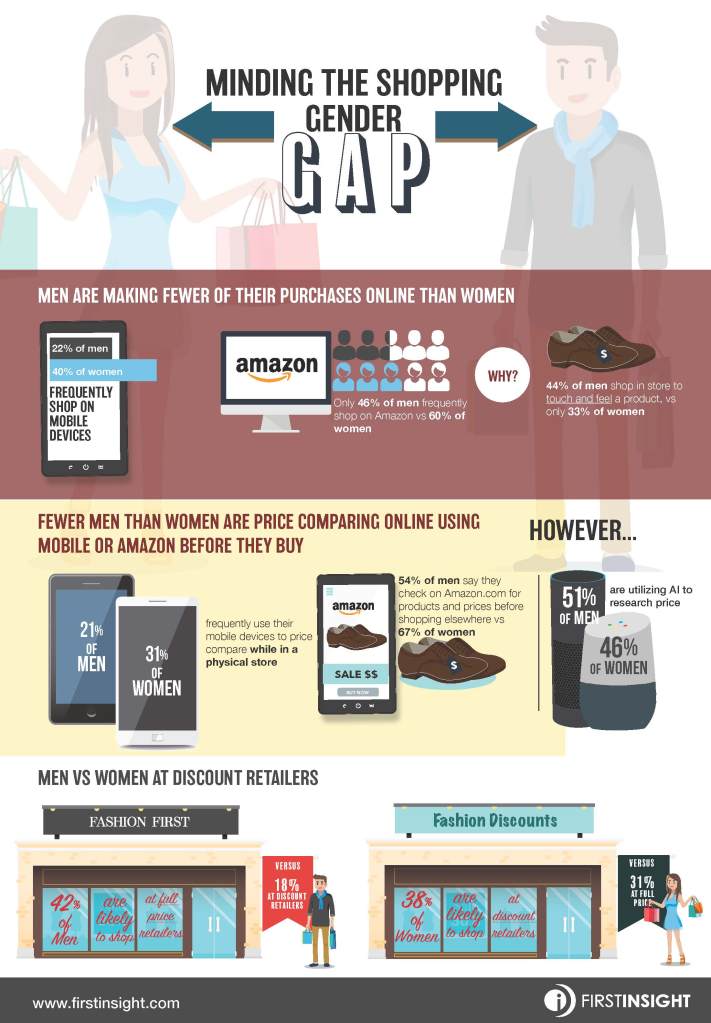
Multiple articles online and people that I’ve asked mentioned that men typically like to touch and feel the products first in-store rather than purchasing products online. Women are more inclined to just purchase the product without having to feel the texture or fabric, which in turn creates more incentive to online shop. Since men typically enjoy physically going to stores and touching a product before they buy it, that does not encourage online shopping as much as women’s tendencies do.
Another difference in men’s and women’s online shopping habits is the viewpoints of the different genders. Bogdan Rancea wrote an article on ecommerce-platforms.com that states, “Based on a survey conducted by the Key Note Media Centre, males tend to view shopping as a chore… Women, on the other hand, treat shopping as a fun event.” (Rancea, 2019). In society, shopping has been viewed as a women’s thing to do, and when you go to a place like the mall you often see men sitting or standing outside of stores waiting for their female counterparts. The same can be seen in online shopping. Women tend to windowshop and browse more than men do, since men typically look at shopping has a necessity rather than as a fun thing to do.
The book Internet Retailing and Future Perspectives details an additional difference between male and female shoppers, saying, “Differences between male and female shopping styles may go back a long way. In hunter-gatherer societies, females tend to carry babies, are based around the camp and do the gathering. Males on the other hand are more likely to protect the group and do the hunting. Humans may have evolved in such a way that those best at their respective roles have been more likely to find a mate and to survive.” (Pantano, 2017). This is interesting because this suggests that the differences that we see in how men and women shop online may be due to a primal instinct from early human societies. This is the most interesting and, in my opinion, the most scientific basis for the reasoning behind the difference in male and female shoppers.
Shopping online has become so easy that virtually anyone can figure it out. Even children are buying products online through AI technology and virtual assistants. This means that more and more people are buying products online, which gives us many more subjects to study to see the differences between male and female shoppers in the online realm. I’m excited to see what else is uncovered!
Resources:
Laurenthomas. (2018, March 19). Men aren’t willing to shop online as much as women, survey finds. Retrieved from https://www.cnbc.com/2018/03/19/men-arent-willing-to-shop-online-as-much-as-women-survey-finds.html
Pantano, E., Bang, N., Dennis, C., Merrilees, B., & Gerlach, S. (2017). Internet retailing and future perspectives. Abingdon, Oxon: Routledge.
Rancea, B., & Rancea, B. (2019, February 20). Male Shopping Habits Versus Female Shopping Habits. Retrieved from https://ecommerce-platforms.com/articles/male-shopping-habits-versus-female-shopping-habits
 Jess's MKTG312 Blog